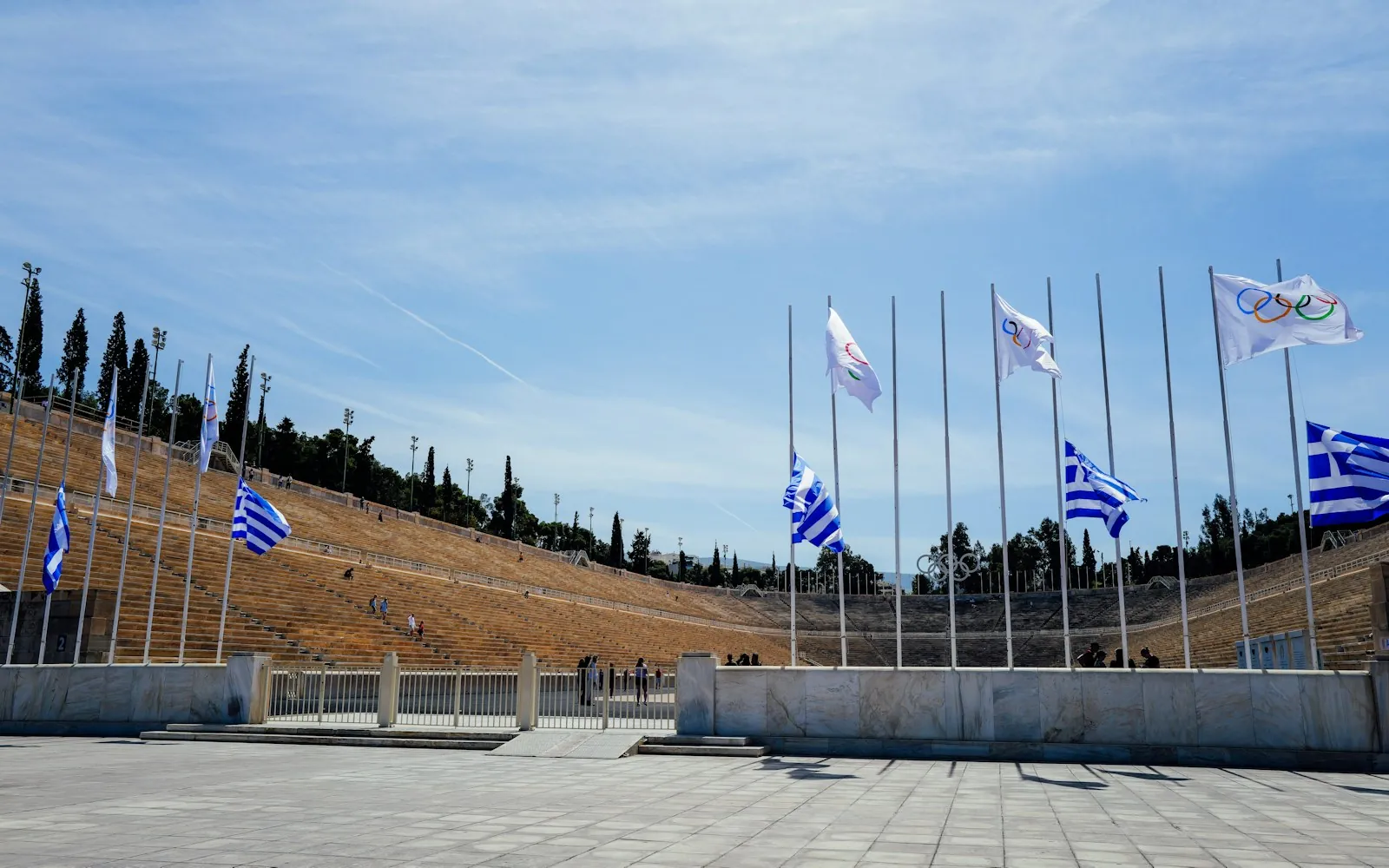
Athens Marathon 2026: tracking, the climb to Stavros and the Panathenaic Stadium finish
8 November 2026: official tracking and live GPS, the climb to Stavros at km 31, where to see your runner twice by metro, and a cheer at km 30.
In this article
The Athens Marathon The Authentic runs on Sunday 8 November 2026, starting at 08:30 in the town of Marathon (official race page). It follows the historic route from Marathon to Athens, one way: flat along the coast at first, then a long climb inland to about km 31, then downhill through the city to a finish inside the marble Panathenaic Stadium, where the 1896 Olympics were held. If you have a runner in it, this guide explains how to see where they are at any moment, where you can actually get to on race morning, and how to reach them with your voice on the worst of the climb.
Independence notice: Cheerlify is an independent service. It is not affiliated with the organisers of the Athens Marathon The Authentic or its sponsors, and it is not the event's official application.
The race at a glance
| Date | Sunday 8 November 2026 |
| Start | 08:30, Marathon, in blocks until about 10:15 (indicative times) |
| Finish | Panathenaic Stadium, Athens; the last 170 m are on the stadium track, and entry for spectators is free |
| Time limit | 8 hours; all finishes by 18:15, with intermediate cut-offs every 2.5 km |
| Bib pick-up | allwyn Marathon EXPO, Faliro indoor hall (Old Poseidonos Avenue / Moraitini Street): Wed 4 November 12:00–21:00, Thu 5 and Fri 6 November 10:00–21:00, Sat 7 November 10:00–20:00 |
| Field | the 2026 marathon is sold out; the organisers count about 75,000 runners across all of the weekend's races (official site) |
Block 1 (elite and sub-3:00) goes at 08:30 and block 15 at 10:09; the last runner should cross the start mat at about 10:15. The organisers call these times indicative and say they'll fix them two weeks before the race (race page). The expo hours above come from the Expo page. The race page lists slightly longer hours for the bag drop at the same hall, so look at both in race week.
Mind the clocks: Greece is on UTC+2 by race day. The 08:30 start is 07:30 in Central Europe and 06:30 in the UK and Ireland. The organisers' buses take runners out of central Athens between 05:00 and 07:45, so your runner's alarm goes off very early.
1. Official tracking: the race app and timing every 5 km
The bib carries a chip, and it's read at the start, every 5 km, at halfway (21.1 km) and at the finish (race page). In the official Athens Authentic Marathon app (free for iOS and Android) you can save up to 20 runners. It also has optional live tracking: if your runner turns it on, the app shows their GPS position; if they don't, it estimates their place on the course from the splits (app page). You don't need a login to watch. Results go up on the official results page.
- Install the app before Sunday and add your runner by name or bib number. While you're at it, ask them whether they plan to switch on the app's live tracking.
- The split and finish times from the timing mats are the official record, and nothing else you'll see on the day is as accurate.
- Without live tracking, the app only moves when a mat is crossed. At a typical marathon pace that's 25–35 minutes between readings, and in the meantime you're looking at the last one. We explain the difference here: chip timing vs GPS tracking.
2. Live GPS on the map, between the readings
A dot that actually moves needs GPS from the runner's own phone. That can be the official app's live tracking, Strava Beacon, Garmin LiveTrack, plain location sharing or Cheerlify; we went through them in marathon tracking apps compared. Cheerlify puts the dot on the course line, shows the kilometre they're on and estimates when they'll reach any point you choose. In Athens that's how you know when to leave Mesogeion Avenue for the metro, and how much time you have before they pass Syntagma.
Tip: keep the official app open next to the GPS dot. The mats give you exact splits every 5 km, and the dot tells you whether your runner is still on the climb to Stavros or already heading down into Agia Paraskevi.
The course, stage by stage
Based on the organisers' course description on the race page, with kilometres checked against the course in the Cheerlify race catalog. Treat them as approximate:
| km | Where |
|---|---|
| 0 | Marathon, start |
| 0–4 | Marathonos Avenue, slightly downhill |
| 4–6 | a loop around the Tymvos, the burial mound of the Battle of Marathon |
| 6–10 | Nea Makri, flat |
| 11–17 | partly uphill, then a steep descent before the Rafina junction |
| 20–25 | Pikermi, rolling; halfway at 21.1 km; a long climb begins around km 25 |
| 27–28 | Pallini, uphill |
| 30–31 | Gerakas and the Stavros junction, the last and hardest climb; the top is at about km 31, some 250 m above sea level |
| 32–36 | steep descent into Agia Paraskevi, then Mesogeion Avenue through Chalandri and Cholargos |
| 36–37.5 | past the Ministry of National Defence (Ethniki Amyna), downhill to the Katechaki junction |
| 39–40 | onto Vasilissis Sofias Avenue; Eleftherias Park at km 40 is the last aid station |
| 41 | past Syntagma, left into Irodou Attikou Street (41.2 km) |
| 42.2 | the last 170 m on the track of the Panathenaic Stadium (finish) |
The road starts rising around km 11, in waves at first. After Pikermi it hardly lets up until Stavros: in the catalog elevation data it goes from about 10 m near Nea Makri to about 250 m at km 31. From there it's mostly downhill to the stadium. The lungs get a break, but by then the quads have 31 km in them and every downhill step hurts. Between km 25 and km 31 is where a familiar voice helps most.
Where to watch
On a one-way course you won't see your runner five times. The first 30 km go through Marathon, Nea Makri, Pikermi and Pallini, which are hard to get to on race morning without a car, and Marathonos Avenue closes to traffic at 08:00. Most supporters stay in Athens and ride metro line 3, which runs under Mesogeion Avenue and on into the centre. Here's what we'd do:
- Ethniki Amyna or Cholargos (about km 35–36). Both are line 3 stations on Mesogeion Avenue, right beside the course after the long descent from Stavros. Your runner is past the climb here, with 6–7 km left.
- Katechaki (about km 37.5), one stop further in, at the bottom of the descent.
- Syntagma and Vasilissis Sofias (about km 40–41). From Ethniki Amyna it's a few stops on line 3 to Evangelismos or Syntagma, and your runner needs roughly 25–40 minutes for those 5 km. Check the arrival estimate before you go down to the platform. Done this way, two sightings is realistic.
- The Panathenaic Stadium. Spectators get in free (spectator guide), and it's about 1 km from Syntagma, Akropoli and Evangelismos metro stations. If the finish is what you want to see, go straight there. The streets around it are packed, and a third roadside spot on the way usually means missing the finish.
Central Athens is closed to traffic on race day from 05:00 to 18:20, and the organisers point everyone to the metro. Spectators may not run or cycle alongside the runners or step into their lane. There's no official meeting point after the finish. Runners collect their bags at the Zappeion, next to the stadium, so pick a spot near there. Following from home works too: the GPS dot and the cheers reach you and your runner the same way wherever you are.
Weather
Early November in Athens is usually mild. The later blocks start after 10:00, though, and they're on the climb around midday, so sun can matter as much as rain. Dress in layers, carry water, and look at the forecast on Saturday.
Be in their ears on the climb to Stavros
The long climb starts near Pikermi and only really ends at the Stavros junction, km 31. By then your runner has 30 km in their legs, a lot of it uphill, and Athens still isn't in sight.
With Cheerlify you can send a voice or video cheer while they're running, and it plays straight away. You can also record one in advance and choose the kilometre where it plays. It comes through their earbuds: the music drops, they hear you, then the music is back. Three kilometres that suit a timed cheer:
- km 26, after Pikermi: "This is the long one. Short steps, steady breathing, it ends at Stavros."
- km 30, near the top at Stavros: "One more kilometre up. After the top it's downhill to the stadium."
- km 41, on Irodou Attikou, with the stadium a few hundred metres away: the thing you'd shout if you were standing at the rail.
The organisers allow headphones at a low volume, so runners can still hear what's going on and any announcements (race page). A cheer comes through fine on one earbud or open-ear headphones.
For the runner: in the Cheerlify app, pick Athens Marathon The Authentic from the race catalog. The official course is already loaded, so you don't need a GPX file. Share the link and the code with your supporters.
Supporters just open the link in a browser and type the code; there's nothing to install and no account to make. If several of you are following, each person can send their own cheer, live or set for a different kilometre. Stuck for words? We collected 30+ cheering lines for every stage of a race.
Race-week checklist for supporters
- Your runner's bib number and block saved. Block 1 starts at 08:30 Athens time, the last at about 10:09. The official app installed and your runner added to it.
- The time difference sorted: Athens is one hour ahead of Central Europe and two ahead of the UK.
- Your runner's GPS tracking link in hand, and tested once during the week.
- Their phone fully charged at the start, battery saver off, location permission set to "Always". It stays on from the early bus to the stadium, which makes for a long day.
- Cheers ready: at least one for the climb to Stavros (km 26–31) and one for the finish. You can also send one live on the day.
- If you're in Athens: spots chosen (Mesogeion Avenue, then Syntagma or the stadium), line 3 stations checked, and a meeting point near the Zappeion agreed.
Frequently asked questions
How can I track a runner at the Athens Marathon?
Add them in the official Athens Authentic Marathon app by name or bib number. The chip is read every 5 km and at halfway, and if your runner switches on the app's optional live tracking you'll see their GPS position as well. GPS tracking from the runner's phone, for example with Cheerlify, keeps the dot moving between readings and gives an arrival estimate for any point.
What time does the Athens Marathon 2026 start?
At 08:30 on Sunday 8 November 2026 in Marathon, in blocks; the last block goes at about 10:09. The organisers confirm the block times two weeks before the race.
Where is the finish?
Inside the Panathenaic Stadium in central Athens. Runners do the last 170 m on the track, and spectators get in free.
Can I see my runner more than once?
Twice is realistic. Watch on Mesogeion Avenue near Ethniki Amyna or Cholargos (about km 35–36), then take metro line 3 to Evangelismos or Syntagma for the last kilometre, or go to the stadium.
What is the time limit?
8 hours, and every finish has to be in by 18:15. There are intermediate cut-offs every 2.5 km; the official race page lists them.
Can I follow from another country?
Yes. The GPS dot moves in real time wherever you are, and your cheers play in their earbuds the same way, whether you send them live or set them for a kilometre beforehand.
Running a race? Take your supporters with you.
Load your race in the Cheerlify app and share one link. Your friends and family follow you live on the course map, and their voice cheers play in your earbuds the moment they're sent, or at the km they pick. Free live tracking.
Keep reading

Marathon du Cognac 2026: tracking, the Charente cycle path and the finish in Jarnac
Saturday 14 November 2026 in Jarnac: what the official timing shows, live GPS, where to see your runner three times, and a voice cheer at km 29.
10 min read →
Deauville Marathon 2026: tracking, two laps and the finish on Les Planches
15 November 2026: official live timing, GPS between the readings, seeing your runner twice on Les Planches, and a voice cheer in the lanes of Tourgéville.
10 min read →
What to say to a runner: 30+ cheers for every stage
The one page to open before you record your first cheer.
2 min read →