Valencia Marathon 2026: tracking, the Alameda double and km 32
Sunday 6 December 2026: the official tracking app, the course km by km, where to see your runner twice, and how to be in their earbuds at km 32.
In this article
The Valencia Marathon Trinidad Alfonso Zurich runs on Sunday 6 December 2026. It's one of the biggest marathons in Europe: up to 36,000 bibs, a record 30,777 finishers in 2025, and, for the first time, a ballot to get in. If someone you care about got one of those places, this guide covers how to know exactly where they are on the day, whether you're on the Paseo de la Alameda or at home in another country, and how to get your voice to them when it gets hard.
You'll have two tools, and they work best together: the organiser's official chip tracking, and continuous GPS tracking from the runner's phone.
The race at a glance
| Date | Sunday 6 December 2026 |
| Start | 8:15, in 9 waves by predicted time; the last wave goes at 9:35 |
| Start line | Plaça de la Marató, by the Puente de Monteolivete |
| Finish | the blue platform over the lake in front of the Hemisfèric, City of Arts and Sciences |
| Time limit | 5 h 30 from crossing the start line; the course closes at 15:15, and runners reaching km 25 after 12:57 are taken out (regulations) |
| Bib pickup | Expo at Feria Valencia: Thu 3 Dec 17:00–21:00, Fri 4 Dec 9:00–21:00, Sat 5 Dec 9:00–19:00; no bibs on race day |
| Course | one flat loop through the city: the university district, El Cabanyal, the old town and back |
| Field | up to 36,000 bibs; 2026 is the first ballot year |
Check the official race site again in race week, because wave times, closures and transport are only confirmed then.
1. The official tracking: the "Maratón Valencia" app
The organiser's free app, Maratón Valencia (iOS and Android), tracks every participant live, with splits at each timing point, speed, predicted finish and a course map. Look up your runner by name or bib number, and do it before race morning, while the app isn't carrying tens of thousands of other supporters.
A few things to know:
- It updates at the timing mats. Between two mats the app estimates where your runner is from their last split, so if they slow down after halfway, the dot won't reflect it until the next mat. Every chip system works this way; we explain why in chip timing vs GPS.
- You need their wave as well as the gun time. Nine waves go off between 8:15 and 9:35, so a runner in the last wave crosses the start more than an hour after the elite, and their clock only starts then.
- It has its own GPS mode. Under the regulations, the runner can switch on GPS tracking from their own phone in the app and choose who sees it: public, PIN code only, or hidden. If they pick PIN, ask them for it; if they pick hidden, you'll only see the mats.
- Download it in advance. On race morning the mobile networks around the start and finish are crowded.
2. Live GPS on the map
To see that your runner is on Avenida de Aragón right now and not still on the Alameda, you need their phone's GPS. Strava Beacon, Garmin LiveTrack, a plain location share or Cheerlify can all do that, and we compare them in marathon tracking apps compared.
On a big city course, Cheerlify helps in two ways. It matches the dot to the course, so it stays on the route between the tall buildings of the old town, and it estimates when your runner will reach any kilometre. That's how you know whether to leave the café now or in ten minutes.
Tip: watch both. At the mats the chip is exact; GPS fills the 25–35 minutes between them.
The course, kilometre by kilometre
From the organiser's official 2026 split list (PDF):
| km | Where |
|---|---|
| 0 | Puente de Monteolivete (start) |
| 5–7 | Avenida de los Naranjos (Tarongers), the university district |
| 10–11 | Ronda Norte, Avenida de Alfahuir |
| 14 | Paseo de la Alameda |
| 15–17 | Avenida de Aragón (by the Mestalla stadium), Avenida de Blasco Ibáñez |
| 19–20 | Avenida de los Naranjos again |
| 21 (halfway) | Calle de la Reina, El Cabanyal |
| 22–23 | Avenida del Puerto |
| 26 | Paseo de la Alameda again |
| 28–30 | Blanquerías (near the Torres de Serranos), the old town, Poeta Querol |
| 32 | Gran Vía Fernando el Católico |
| 33–36 | Valle de la Ballestera, Avenida Tres Cruces |
| 39 | Calle Xàtiva (Estación del Norte, the bullring) |
| 40–41 | Porta de la Mar, Avenida Jacinto Benavente |
| 42 | City of Arts and Sciences (finish) |
The official list also gives a passing window for each kilometre, from the first wave to the course close. Runners pass halfway between roughly 9:15 and 12:25 and finish between 10:16 and 15:24.
3. Where to stand
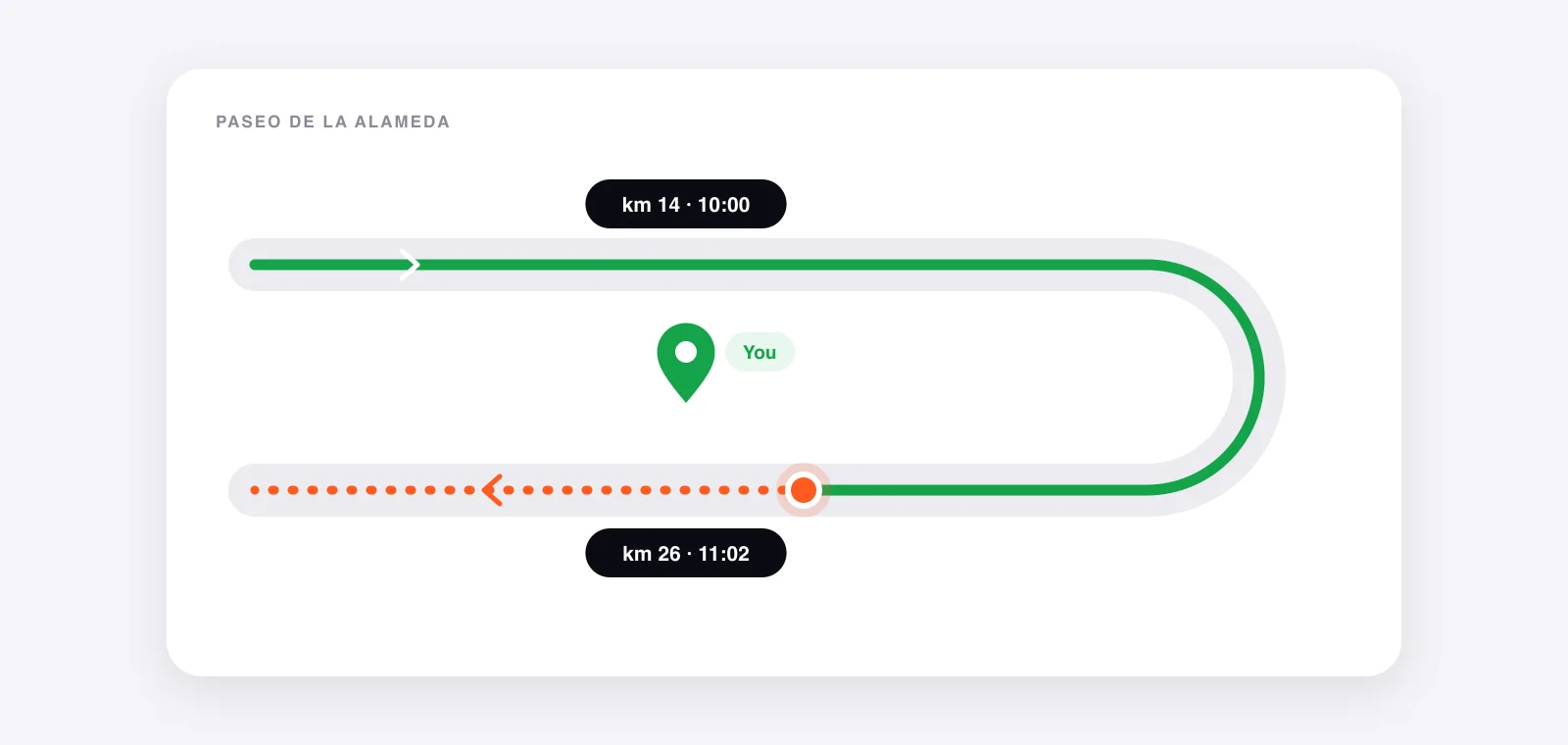
Valencia is a loop, but it doubles back on itself in a few places, and there you can see your runner twice without moving much:
- Avenida de los Naranjos (Tarongers): km 5–7 and again at km 19–20. They're fresh the first time and coming up to halfway the second.
- Paseo de la Alameda: km 14 and again at km 26. The old Turia riverbed gardens run right alongside, so it's easy to walk between points.
- Km 30–33, old town to Valle de la Ballestera: the famous wall stretch, and traditionally one of the loudest. In 2025 the Plaza del Ayuntamiento (around km 30.5) and the "Muro de Colacao" on Valle de la Ballestera (around km 33) were among the biggest music points. A familiar face helps most here.
- The finish: the blue carpet over the water in front of the Hemisfèric looks spectacular and gets very crowded. If you want to see them finish, get there early. If you mainly want to hug them afterwards, agree a meeting point outside the finish area.
The city puts on more than 100 cheering points, with falla groups, charangas and DJs. The 2026 cheering-points map is already up, though the organiser says the full list is still to come. So far it shows a disco bus around km 14, DJs around km 30.5 and 39, and the "Muro de Colacao" at km 33.
Getting around on race morning
In 2025 the course was closed to traffic from 7:00 on Sunday and the start area from Friday night, and a long list of EMT bus lines was diverted or suspended. On Metrovalencia, some tram and metro sections near the course (L4, L6, L8, L10) were cut or started late on race morning. The 2026 plan comes out in race week, so check that rather than last year's.
The advice doesn't change from year to year: don't drive. Pick one or two spots you can reach on foot or by metro, and use the arrival estimate to decide when to move between them. On foot, the Turia gardens through the middle of the course are the easiest way across the city.
Weather
Early December in Valencia is mild. Normal lows are around 7–9 °C and highs around 17 °C, so the start is usually cool and bright, and it can be pleasantly warm by the time the last runners finish. If you'll be standing still for hours, dress warmer than the runners.
4. Get in their ears at km 32
Most runners race with earbuds, and plenty will have music on along Valencia's long, flat avenues. With Cheerlify you record a voice or video message in advance and pick the kilometre (32 is a good one: the Gran Vía, just after the old town), and it plays in the runner's earbuds right there. Their music ducks, your voice comes through, and then the music comes back. You don't need an app or an account, just a link and a code in your browser.
This works just as well from home, so even if you can't be in Valencia, you can still be at km 32.
What should you say? Keep it short and specific, and get the timing right. We keep 30+ lines for every stage of a race, because the start, halfway, km 30 and the finish each call for something different.
Race-week checklist for supporters
- Their bib number, wave and start time saved on your phone.
- The Maratón Valencia app installed and your runner found in it before Sunday. If they use the app's own GPS mode, check it isn't set to hidden, or get the PIN.
- Your runner has shared their GPS tracking link (Cheerlify, Beacon, LiveTrack), and you've tested it the evening before.
- Their phone on full charge, low-power mode off, location permission set to "Always".
- Cheers recorded for the hard part: at least two between km 30 and 36.
- One or two spots chosen (Tarongers at km 5–7 and 19–20, or the Alameda at km 14 and 26), the route there checked against the 2026 transport plan, and a meeting point outside the finish area agreed.
Frequently asked questions
How do I track a runner in the Valencia Marathon?
Use the official Maratón Valencia app (free, iOS and Android). Search by name or bib number to see their splits, speed and predicted finish. Between the timing mats the app only estimates, unless the runner switches on its GPS mode. You can also add a GPS tracker running on their phone, such as Cheerlify.
What time does the Valencia Marathon 2026 start?
The first wave starts at 8:15 on Sunday 6 December 2026, and the rest follow every ten minutes until 9:35. Your runner's wave depends on their predicted time.
Where is the best place to watch the Valencia Marathon?
Anywhere the course passes twice: Avenida de los Naranjos (km 5–7 and 19–20) and the Paseo de la Alameda (km 14 and 26). The most emotional stretch is from the old town to Valle de la Ballestera, around km 30–33.
Can I follow the Valencia Marathon from home, from another country?
Yes. The official app works anywhere, and GPS tracking from the runner's phone shows their position on the map in real time. Valencia is on Central European Time, so for most of Europe the race happens during your own morning.
How long does it take to run the Valencia Marathon?
The time limit is 5 hours 30 minutes from crossing the start line. The official passing times have the fastest runners finishing at about 10:16 and the last ones by 15:24, when the course closes.
Follow your runner live — and be in their ears.
Cheerlify shows your runner's live position on the course map and plays your voice cheers in their earbuds mid-race. Supporters need no app and no sign-up.
Keep reading

Frankfurt Marathon 2026: tracking, the Mainzer Landstraße and the Festhalle finish
25 October 2026: official tracking with timing at every km, live GPS, where to watch twice in the city centre, and a voice cheer at km 31.
9 min read →
Dublin Marathon 2026: tracking, Heartbreak Hill and where to cheer
25 October 2026: the official race tracker, live GPS between the timing mats, the support zones, and how to be in their earbuds on Roebuck Road.
9 min read →
What to say to a runner: 30+ cheers for every stage
The one page to open before you record your first cheer.
2 min read →