Chip timing vs GPS tracking: what each one measures, and why they disagree
The chip on the bib and the phone in the pocket answer different questions. What each measures, why the distance and pace differ, and which to watch when.
In this article
When someone races, two sets of numbers are recorded about them, and the two won't agree. One comes from the chip on the bib, the other from the GPS in a phone. Here's what each one actually measures, why they differ, and which to watch when.
What the chip measures
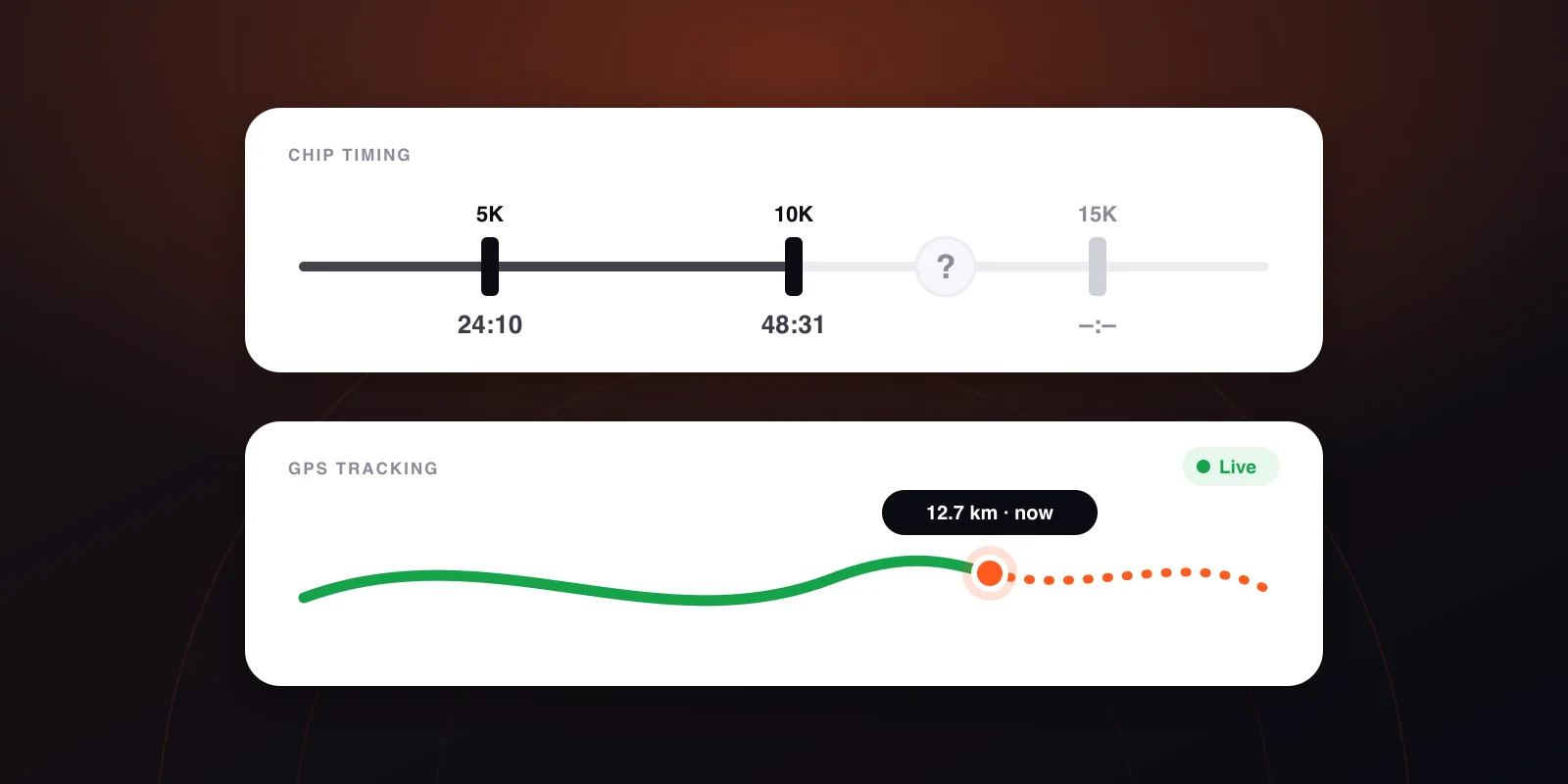
The chip in the bib produces timestamps: when the runner crosses a timing mat, the system records the exact time. That's all it does, and it's exactly why you can trust it.
You get official, verified times at the start, at a handful of intermediate points and at the finish, and both net time (chip to chip) and gun time (from the starting pistol) come from them. Between the mats you get nothing; as far as the system is concerned, the runner doesn't exist there. The chip works with the official distance, so a marathon is 42.195 km even if the runner covered more.
What GPS measures
The phone (or watch) checks where it is every few seconds and joins the points up. That gives you a continuous position, current pace and a predicted finish, and you can see when someone stops. It can't give you an official time, though: a GPS trace isn't a result. The distance it measures is the path actually covered, measurement error included.
Why the distances disagree
This is the question people ask most. There are three causes, and all of them are normal.
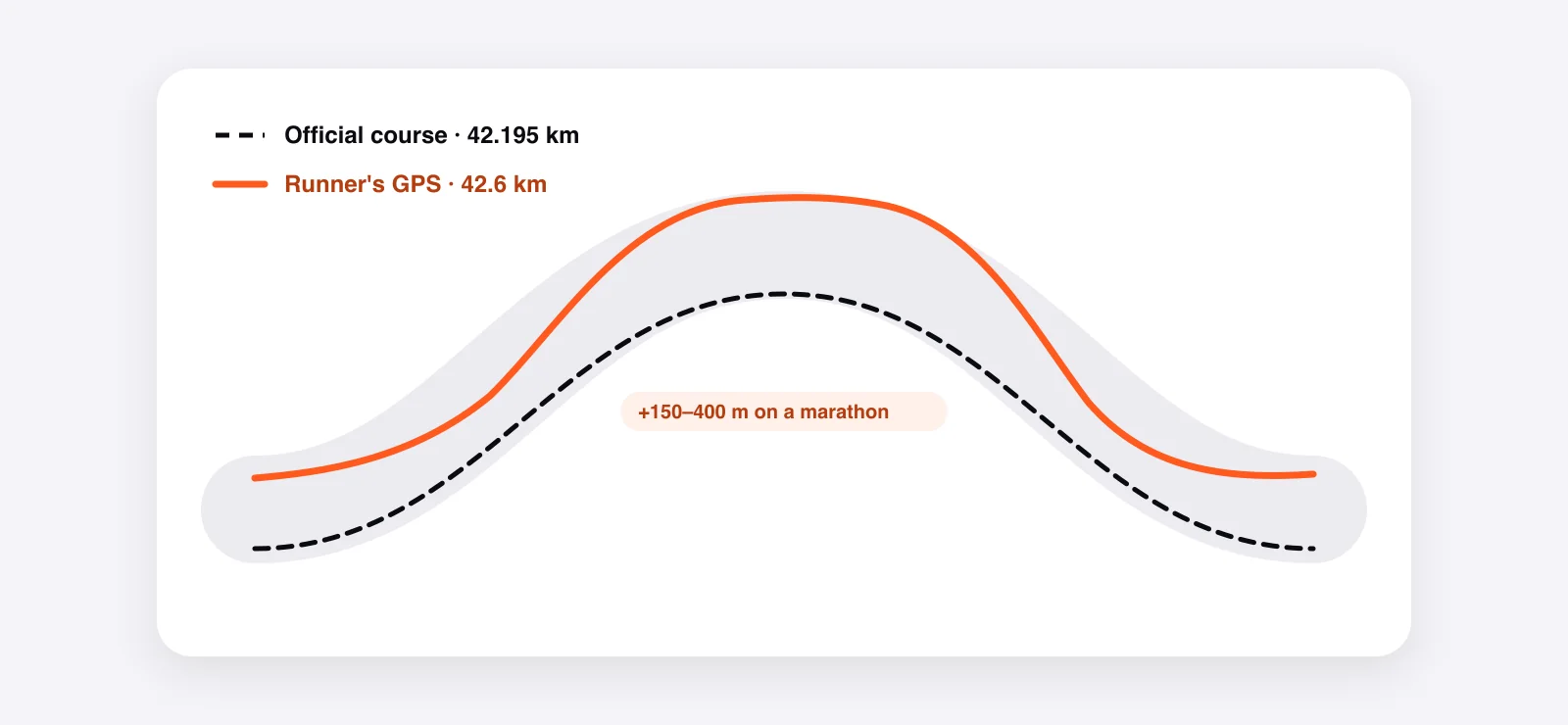
1. The official distance is measured along the shortest legal line. A course is certified on the tightest possible path: the inside of every bend. A runner in a field, weaving between aid stations, is bound to cover more than that. On a marathon 150–400 m extra is entirely ordinary.
2. GPS errs too, and mostly upwards. Receiver error is largest on bends and between tall buildings, and it tends to push the trace outward, so the line bulges and the measured distance grows.
3. A watch and a phone don't agree either. They're two devices with different antennas and sampling rates, and 100–300 m apart on the same run is common.
The thing to remember: the chip gives you the official time, and GPS shows how they got there. You don't have to pick one over the other.
Why the pace differs
Because it's divided by a different distance. Pace from official splits uses the official distance; GPS uses its own. If the runner covered 42.6 km instead of 42.195, their GPS pace looks several seconds per kilometre faster than the official one, even though it's the same run.
That's why our tracking matches the signal to the route: distance is counted along the course rather than by adding up raw GPS points. It keeps the "where are they" a supporter sees close to the official splits.
Which one to watch, and when
| Chip splits | GPS tracking | |
|---|---|---|
| Official time | ✓ | — |
| Visible between two mats | — | ✓ |
| Update rate | every 5–10 km | every few seconds |
| Needs the runner's phone | — | ✓ |
| Shows that they stopped | — | ✓ |
| Basis of the results | ✓ | — |
As a spectator you get the most out of using both: the chip tells you how they officially stand, and GPS tells you where they are now and when to head to your spot on the course.
If one of them stops updating, we have a separate piece on what to do about it.
Frequently asked questions
Which one is "accurate"?
For time, the chip, because it's the official one. For position, GPS, because it shows where they are now. They answer different questions.
Why does Strava/my watch show more kilometres than the official distance?
Because it measures the path actually covered, while the official distance is the shortest legal line. A few hundred metres of difference on a marathon is normal.
Can I use the GPS time as a result?
No. Results are produced from chip timing, and a GPS trace isn't official. It's perfect for a training log, though.
If there is chip tracking, why bother with GPS?
Because the chip is silent between the mats and can't tell you whether your runner has stopped. GPS tracking also makes room for something the chip never will: your voice reaching them while they run.
Follow your runner live — and be in their ears.
Cheerlify shows your runner's live position on the course map and plays your voice cheers in their earbuds mid-race. Supporters need no app and no sign-up.
Keep reading
Race tracker not updating: why, and what to do
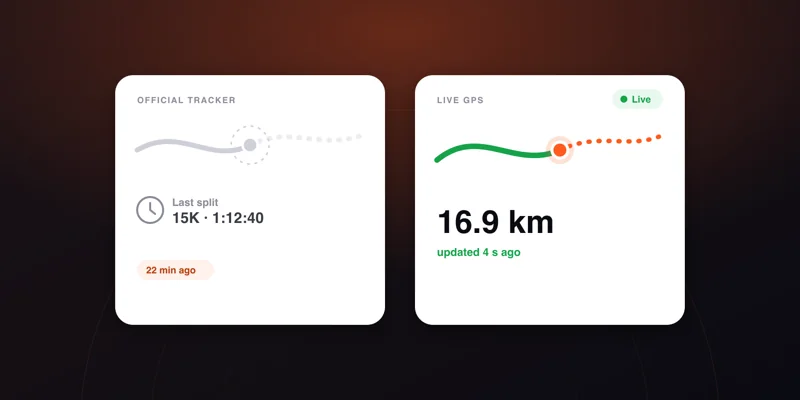
The dot is frozen, or there has been no split for twenty minutes. The causes from most to least likely, and the point at which it is actually worth worrying.
5 min read →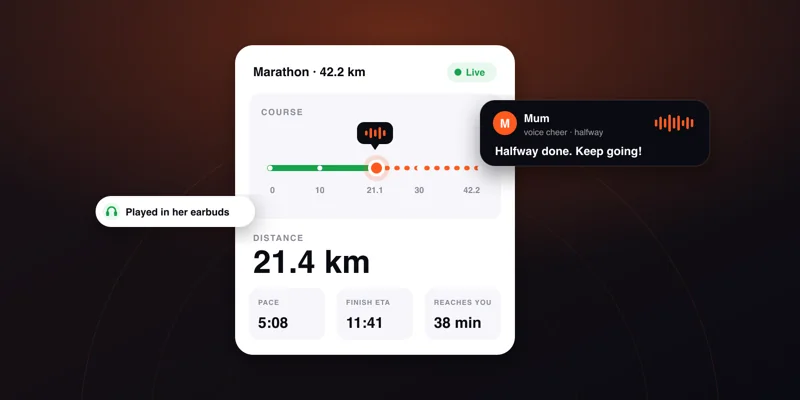
How to track a runner live at a race: the complete guide
Chip splits, GPS tracking, where to stand and what to say. What a spectator can actually see during a marathon, what usually breaks, and the backup plan.
6 min read →
What to say to a runner: 30+ cheers for every stage
The one page to open before you record your first cheer.
2 min read →