NYC Marathon 2026 spectator guide: five boroughs, one runner to find
1 November 2026: the official tracking app, start waves, the course by borough, where to see your runner twice and how to cheer at mile 20.
In this article
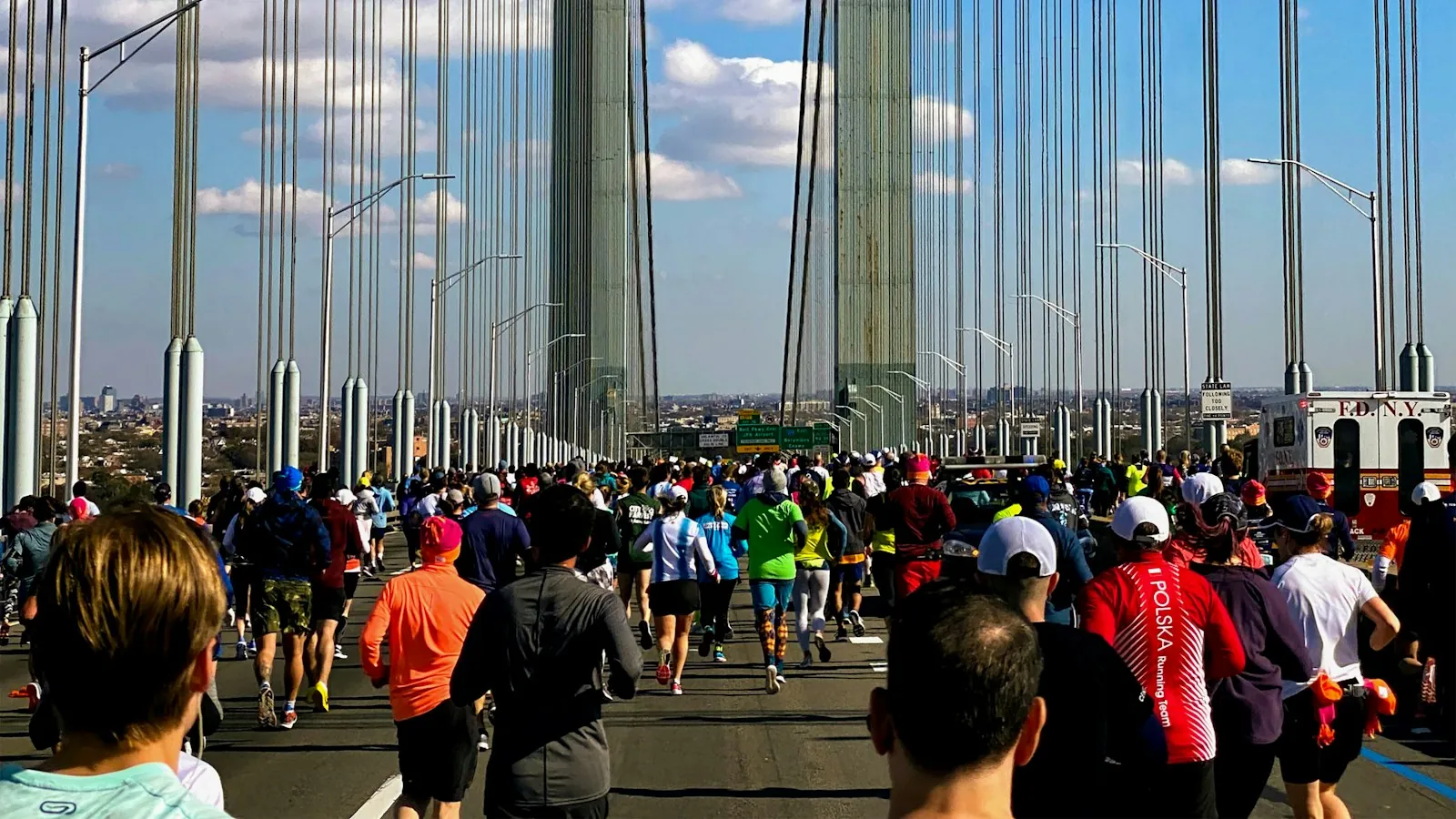
The TCS New York City Marathon runs on Sunday 1 November 2026, and it's the biggest marathon in the world: 59,226 finishers in 2025 from 130 countries, a world record for the second year running. 2026 is also the 50th anniversary of the five-borough course, and the first time in 15 years that the course changes. If someone you care about will be among the 50,000+ on the Verrazzano-Narrows Bridge, this guide shows you how to know exactly where they are, whether you're on First Avenue or following from the other side of the Atlantic, and how to get your voice to them when it gets hard.
You'll want two things running side by side: the organiser's official chip tracking, and continuous GPS tracking from the runner's phone.
The race at a glance
| Date | Sunday 1 November 2026 |
| Start | 5 waves: 9:10, 9:45, 10:20, 10:55 and 11:30 ET, after the pro races (start info) |
| Start area | Fort Wadsworth, Staten Island, runners only, then straight onto the Verrazzano-Narrows Bridge |
| Finish | West Drive at 67th Street, Central Park |
| Time limit | the course stays open at a 16 min/mile pace (about 9:57/km) from the last wave; official results until 10 p.m. (finish info) |
| Course | Staten Island, Brooklyn, Queens, Manhattan, the Bronx, and back into Manhattan to Central Park |
| Field | about 59,000 finishers in 2025 |
If you're following from overseas, watch the clocks: US daylight saving time ends at 2 a.m. on race morning. Wave 1 at 9:10 ET is 14:10 in London and 15:10 in Central Europe.
1. The official tracking: the NYRR app
The organiser's live tracking runs in the free New York Road Runners app (App Store); NYRR's own race pages say friends and family "can track runners" with it. It replaced the old standalone TCS NYC Marathon app, so if you used that one before, install the new one. It shows splits and a predicted finish time.
What to know about it:
- It updates at the timing mats, and New York has a lot of them: every mile from mile 3, every 5K, halfway and the finish. Between two mats the app estimates where your runner is, so if they slow down on the Queensboro Bridge, the dot doesn't know until the next mat. Every chip system works this way; we explain why in chip timing vs GPS.
- Get their wave. The last wave starts more than two hours after the first. The course clocks are set to wave 1, so when a wave 4 runner passes mile 10, the clock reads almost two hours more than their own time.
- Expect it to struggle. NYRR itself warns that phones may not work near the finish because of "cellular saturation", and the app's 2025 reviews complain about slow updates. Install it days before, find your runner in it, and don't rely on one source.
2. Live GPS on the map
To see that your runner is coming off the Queensboro Bridge right now, and not still in Long Island City, you need GPS from the runner's phone. Strava Beacon, Garmin LiveTrack, a location share and Cheerlify can all do it, and we compare them in detail in marathon tracking apps compared.
Cheerlify matches the dot to the course, so it stays on the route between Manhattan's tall buildings, where raw GPS jumps around, and it gives an arrival estimate for any mile. That estimate tells you whether to leave First Avenue for Fifth Avenue now or whether you have ten more minutes.
Watch both: the chip is the accurate number at the mats, and GPS fills the gaps between them. It also keeps working when the official app is slow.
The course, borough by borough
Based on NYRR's recommended viewing locations and the official 2026 course map (PDF). Where we read the mile off the map, it's approximate.
| Mile | km | Where |
|---|---|---|
| 0–2 | 0–3 | Staten Island and the Verrazzano-Narrows Bridge (no spectators) |
| 2–4 | 3–6 | Fourth Avenue, Bay Ridge and Sunset Park, Brooklyn |
| 8 | 13 | Fourth Avenue and Flatbush Avenue, by the Barclays Center |
| 10–13 | 16–21 | Williamsburg and Greenpoint |
| 13.1 | 21.1 | Pulaski Bridge into Queens: halfway |
| 14–16 | 22–26 | Long Island City, then the Queensboro Bridge (no spectators) |
| 16–18 | 26–29 | First Avenue, Manhattan's Upper East Side |
| 18–20 | 29–32 | East Harlem, then the Willis Avenue Bridge into the Bronx |
| 20–21 | 32–34 | The Bronx: the 2026 course change, a new loop via E 135th St, Alexander Ave, E 141st St and Third Ave |
| 22 | 35 | back over the Madison Avenue Bridge, Fifth Avenue in Harlem |
| 23–24 | 37–39 | Fifth Avenue, E 105th–90th St, into Central Park |
| 25–26.2 | 40–42.2 | Central Park South, Columbus Circle, finish on West Drive at 67th St |
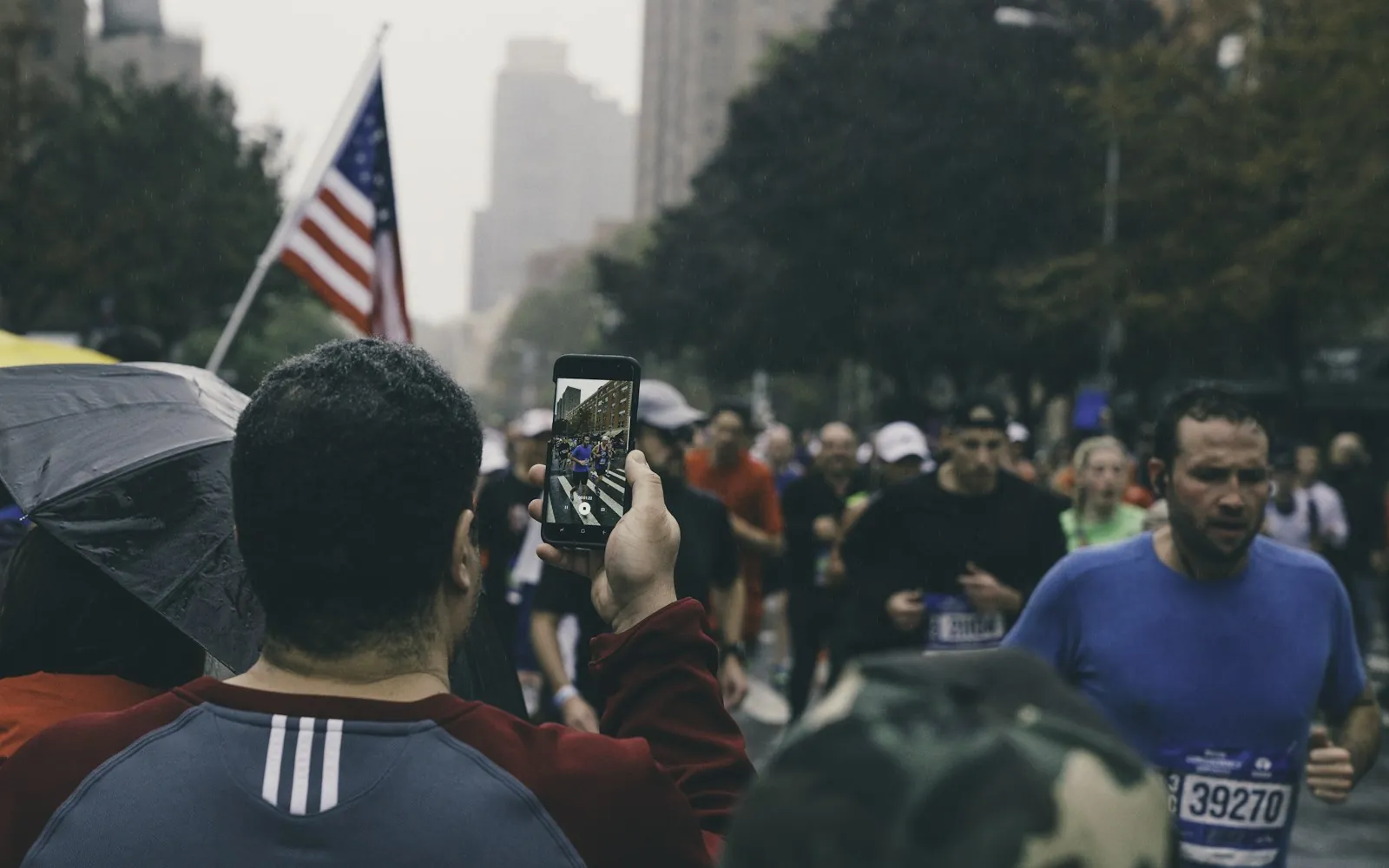
NYRR says "the majority of the course is open to spectators from mile 3 to mile 26." The bridges are not.
3. Where to stand
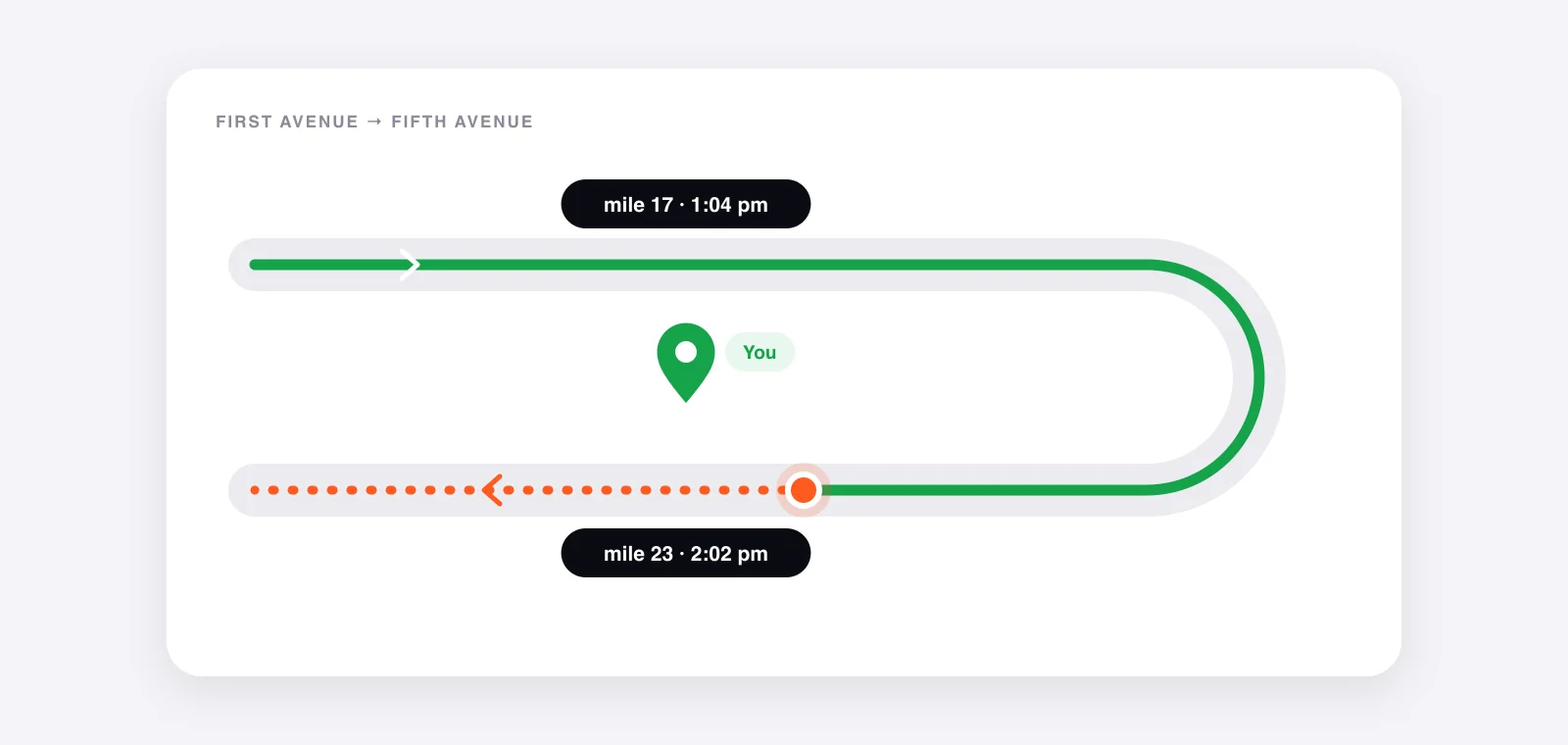
New York is a point-to-point course, so no single spot sees your runner twice. Manhattan does bend the course into a U, though: up First Avenue to the Bronx, then back down Fifth Avenue. The two avenues are only a few blocks apart, while your runner covers about 10 km in between. That's the classic double:
- First Avenue, miles 16–18: after the silent Queensboro Bridge, this is where the noise hits. Subway: N, Q, R, 4, 5, 6 or F. Official crossing points over First Avenue are at 69th, 72nd, 83rd and 86th Street.
- Fifth Avenue, E 90th–105th St, miles 23–24: just before Central Park, when the legs are heavy. Subway: Q, 4, 5 or 6. Walk west from First Avenue while your runner is in the Bronx.
Other good spots, also from NYRR's list:
- Fourth Avenue, Brooklyn (miles 2–4) and Fourth & Flatbush (mile 8): both are on the R line, so you can do these two as well.
- Williamsburg and Greenpoint (miles 10–13): some of the best atmosphere on the course. Subway: G, L, M or J.
- First Avenue and 120th St (miles 19–20): the Charity Cheer Zone, just before the Bronx and the hardest part of the race.
- The finish: grandstand seats need a ticket, but there's a free standing area inside Central Park from Columbus Circle to about 150 m before the line. After the race, runners meet family at the Family Reunion area on W 69th–71st St, by the first letter of the runner's last name (71st: A–F, 70th: G–N, 69th: O–Z).
Getting around on race day
NYRR's advice: "The best way to get around as a spectator is to take the subway." Check mta.info before you travel, because service changes on race day. Streets on the course close from early morning, and you can only cross at the official crossing points.
So pick two spots on the same subway line or a short walk apart, and use the arrival estimate to time your moves. With three bridges where you can't be, the gaps between sightings in New York are long.
Weather
On 1 November, Central Park's normal high is 15 °C (59 °F) and the low 8 °C (46 °F). The bridges are windy. If you'll be standing on an avenue for hours, dress for a cold afternoon, not for running.
4. Get in their ears at mile 20
Most runners race with earbuds. With Cheerlify you record a voice or video message in advance and pick where it should play. Mile 20, about km 32, is the classic: the Bronx, where a lot of runners hit "the wall". At that point the runner's music ducks, your voice comes through, and then the music comes back. You don't need an app or an account, just a link and a code in your browser.
It works just as well from home, and New York has more overseas runners than almost any race. If you can't be in the Bronx, you can still be at mile 20.
As for what to say, keep it short and personal, and fit it to the moment. We keep 30+ lines for every stage of a race.
Race-week checklist for supporters
- Bib number, wave, start colour and corral saved on your phone.
- The New York Road Runners app installed and your runner found in it, before Sunday.
- Your runner has shared their GPS tracking link (Cheerlify, Beacon, LiveTrack), and you've tested it the evening before.
- Their phone fully charged, low-power mode off, location permission set to "Always".
- Cheers recorded for the hard part: at least two between mile 18 and 24.
- Your two spots chosen (First Avenue and Fifth Avenue is the classic), the subway route checked on mta.info, and the Family Reunion letter agreed.
- Watching from overseas? Work out the time difference after the US clock change on race morning.
Frequently asked questions
How do I track a runner in the NYC Marathon?
Use the free New York Road Runners app. It shows splits from timing mats every mile from mile 3, every 5K and at halfway, plus a predicted finish time. For their live position between mats, add a GPS tracker running on their phone.
What time does the NYC Marathon 2026 start?
The wheelchair races start from 8:00 ET and the pro men at 9:05. The five waves go at 9:10, 9:45, 10:20, 10:55 and 11:30 ET on Sunday 1 November 2026. US clocks go back an hour at 2 a.m. that morning.
Where is the best place to watch the NYC Marathon?
First Avenue (miles 16–18) and then Fifth Avenue between 90th and 105th Street (miles 23–24): a few blocks apart for you, about 10 km apart for your runner. Williamsburg and Greenpoint (miles 10–13) have some of the best atmosphere.
Can I follow the NYC Marathon from another country?
Yes. The official app works anywhere, and GPS tracking from the runner's phone shows their position on the map in real time. From Central Europe, wave 1 starts at 15:10 and most runners finish in the evening.
What is the time limit for the NYC Marathon?
The course stays open at a 16-minute-per-mile pace (about 7 hours) from the last wave start, and official results are recorded until 10 p.m. ET.
Follow your runner live — and be in their ears.
Cheerlify shows your runner's live position on the course map and plays your voice cheers in their earbuds mid-race. Supporters need no app and no sign-up.
Keep reading

Frankfurt Marathon 2026: tracking, the Mainzer Landstraße and the Festhalle finish
25 October 2026: official tracking with timing at every km, live GPS, where to watch twice in the city centre, and a voice cheer at km 31.
9 min read →
Dublin Marathon 2026: tracking, Heartbreak Hill and where to cheer
25 October 2026: the official race tracker, live GPS between the timing mats, the support zones, and how to be in their earbuds on Roebuck Road.
9 min read →
What to say to a runner: 30+ cheers for every stage
The one page to open before you record your first cheer.
2 min read →