Amsterdam Marathon 2026: follow your runner from the Vondelpark to the Amstel
Sunday 18 October 2026: the official tracking app, start waves, the course km by km, where to see your runner twice, and how to be in their earbuds at km 30.
In this article
The TCS Amsterdam Marathon runs on Sunday 18 October 2026, and this year's is the biggest yet: 32,000 marathon places split over two start areas, a half marathon in the afternoon, and more than 60,000 runners across the weekend, over half of them from abroad. If someone you care about is one of them, this guide shows you how to know exactly where they are on Sunday, whether you're on the Stadhouderskade or at home in another country, and how to get your voice to them when it gets hard.
You'll want two things running side by side: the organiser's official chip tracking, and continuous GPS tracking from the runner's phone.
The race at a glance
| Date | Sunday 18 October 2026 |
| Start | 9:00, in 6 waves by expected finish time; the last wave goes at 9:43 |
| Start areas | Area A on the field inside the Olympic Stadium, Area B on Stadionweg just outside it; the two streams merge after about a kilometre |
| Finish | inside the Olympic Stadium, in front of the main stand |
| Time limit | 6 hours; the finish closes at 17:00 (marathon info) |
| Course | Vondelpark and the Rijksmuseum, the Zuidas, south along the Amstel to Ouderkerk aan de Amstel and back, then east Amsterdam and back through the centre |
| Field | 32,000 in the marathon; the half marathon starts at 13:20 |
Always check the official site in race week. Runners get their start area and wave by email in the final days, so ask yours to pass it on.
1. The official tracking: the Le Champion app
The organiser's live tracking runs in the free Le Champion app (iOS and Android). Open it, choose the TCS Amsterdam Marathon, and you can follow a runner's position on the course and their expected finish time. MYLAPS does the timing, and the official results go up on Sporthive afterwards.
What to know about it:
- It updates at the timing mats, every 5 km. Between two mats the app estimates where your runner is from their last split, so if they slow down on the Amstel, the dot doesn't know until the next mat. Every chip system works this way; we explain why in chip timing vs GPS.
- Get the wave, not just the gun time. The waves go from 9:00 (white, invited athletes) to 9:43 (blue, 4:30–6:00 runners). A runner in the blue wave crosses the line three quarters of an hour after the elite, and that's when their clock starts.
- Install it before Sunday, because mobile networks around the stadium are crowded on race morning. The official page still links an older standalone app as well; Le Champion is the one you want.
2. Live GPS on the map
To see that your runner is on the Ouderkerkerdijk right now, and not still on the other bank of the Amstel, you need GPS from the runner's phone. Strava Beacon, Garmin LiveTrack, a location share and Cheerlify can all do it, and we compare them in detail in marathon tracking apps compared.
Cheerlify matches the dot to the course, so it stays on the right bank of the river and on the route between the canal houses, and it gives an arrival estimate for any kilometre. That estimate tells you whether to get on the metro now or whether you have ten more minutes.
Watch both: the chip is the accurate number at the mats, and GPS fills the 25–35 minutes between them.
The course, kilometre by kilometre
The kilometres are approximate, read off the official 2026 course map (PDF):
| km | Where |
|---|---|
| 0–1 | Olympic Stadium / Stadionweg, then Amstelveenseweg |
| 2–3 | Vondelpark |
| 4 | through the Rijksmuseum passage, then the Stadhouderskade |
| 5 | Hobbemakade, Ferdinand Bolstraat |
| 6–9 | Beethovenstraat, a loop through the Zuidas business district, back up Beethovenstraat |
| 10–13 | Apollolaan, Churchilllaan, Rijnstraat, President Kennedylaan |
| 14 | onto the Amstel at Zorgvlied |
| 15–19 | south along the west bank of the Amstel to Ouderkerk aan de Amstel |
| ~19.5 | the turn: across the bridge in Ouderkerk |
| 20–25 | back north on the east bank (Ouderkerkerdijk); halfway is on this stretch |
| 26–30 | Overamstel, Van der Madeweg, Amstel Business Park, Venserpark |
| 31–35 | Middenweg, Galileïplantsoen, Molukkenstraat, Zeeburgerdijk |
| 36–37 | past Artis, under the Wibaustraat and over the Torontobrug |
| 38–39 | Stadhouderskade and the Rijksmuseum passage again |
| 40–42 | Vondelpark, Amstelveenseweg, finish in the Olympic Stadium |
The sweeper cut-offs give the latest possible times: 10 km at 11:13, 20 km at 12:36, 25 km at 13:18 and the finish at 17:00.
3. Where to stand
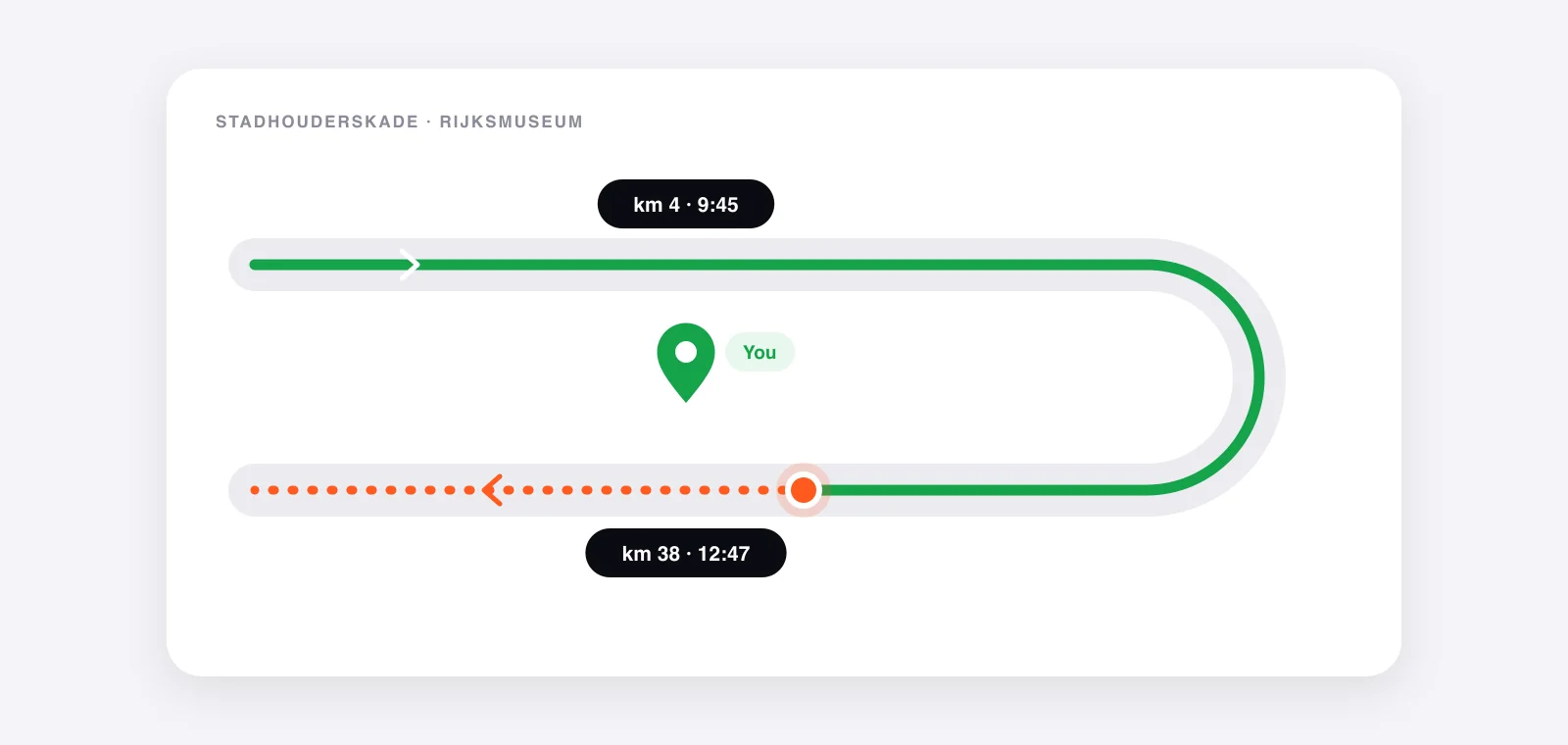
Amsterdam starts and finishes in the same place and comes back through the centre at the end, so from several spots you can see your runner twice without moving much. The official spectator page names these:
- Vondelpark: at km 2 and again at km 40. The first time it's a crowded wave of fresh runners; the second is two kilometres from the finish, where a familiar face counts for a lot.
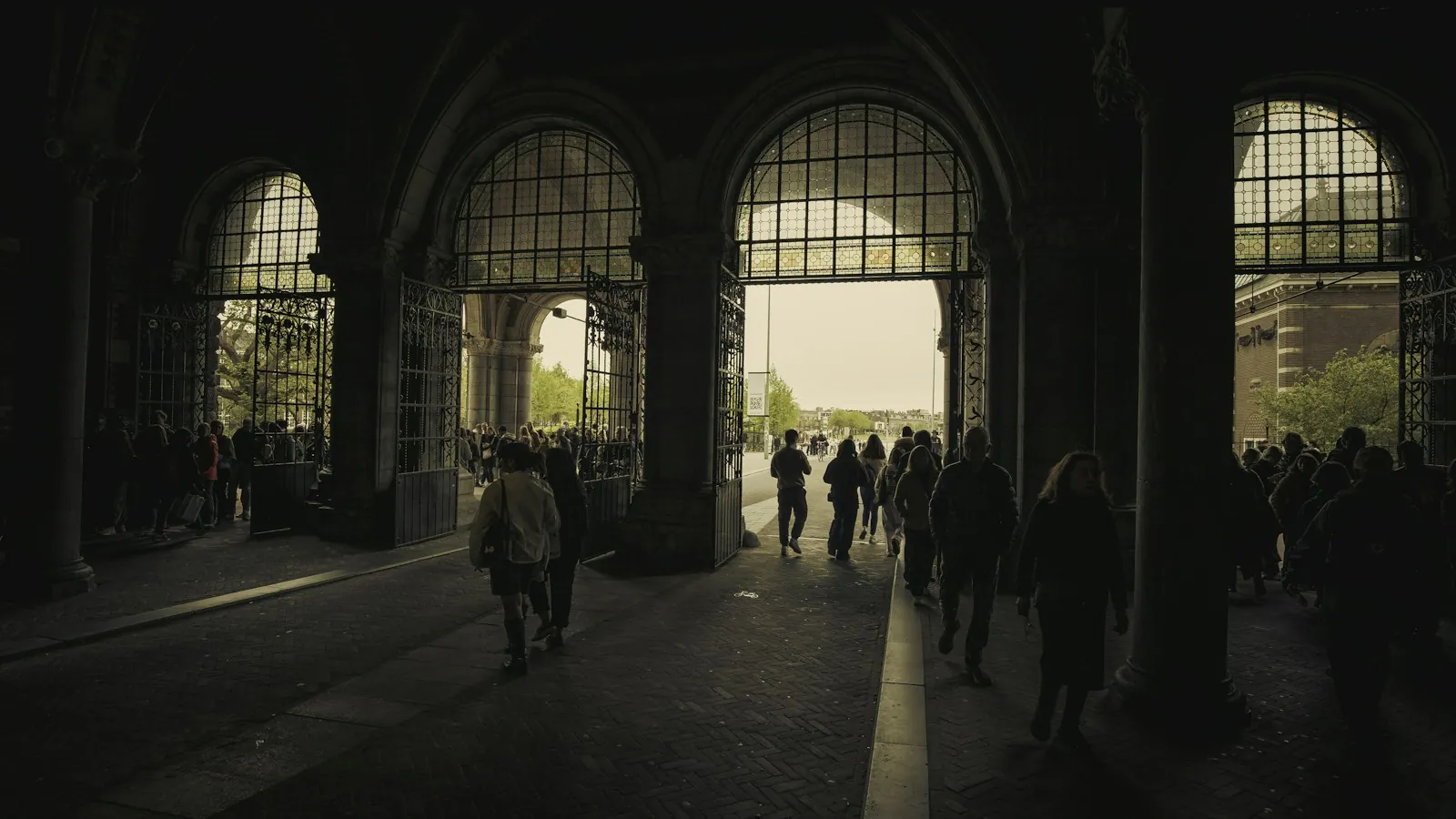
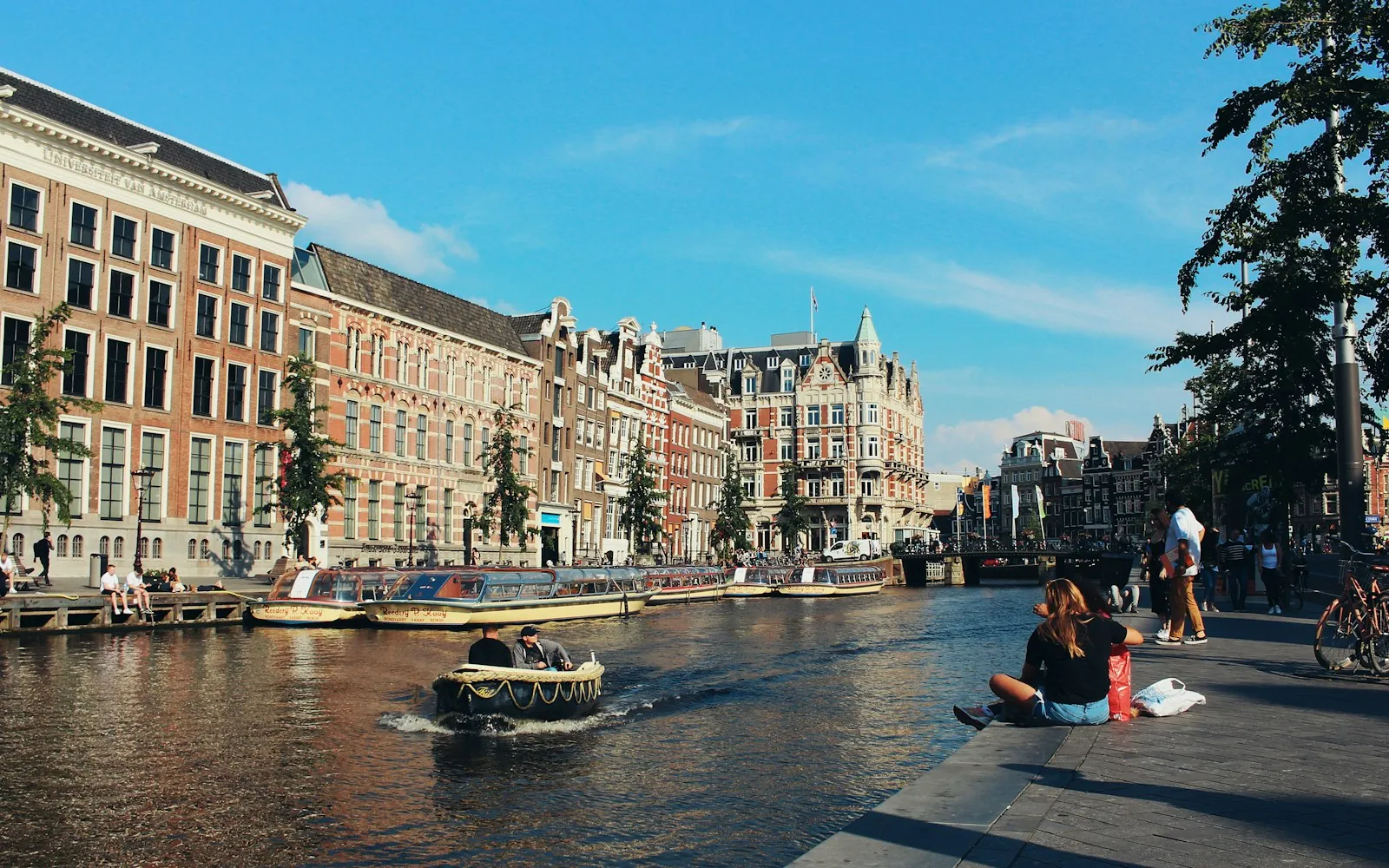
- Stadhouderskade / Rijksmuseum: at km 4 and around km 38–39. Runners tend to remember going through the passage under the Rijksmuseum. Metro: Vijzelgracht or De Pijp.
- Beethovenstraat: at about km 6 and km 9, on the way into and out of the Zuidas loop. Metro: Zuid.
- The Amstel (km 14–26): the quietest and prettiest part of the course. The two legs run on opposite banks, so one spot sees your runner once, except near the turn in Ouderkerk (around km 19–20), where you can catch them going both ways. That's our reading of the map, not an official claim. There's no metro to Ouderkerk; for the northern end of this stretch, use metro RAI.
- Amstel Business Park (km 26–31): the organiser promises "lots of music, entertainment", and it's where the race starts to bite. Metro: Overamstel or Van der Madeweg.
- Wibaustraat / Torontobrug (km 37): five kilometres from the finish. Metro: Weesperplein.
If you want to be at the finish, the Olympic Stadium has covered stands, and the Fan Zone has flagged meeting points. Agree on one before the start.
Getting around on race day
The travel advice says to take the metro. Large parts of the city are closed to traffic, and trams and buses in the centre only run in part. The nearest stations for the stadium are Station Zuid and Amstelveenseweg, but Amstelveenseweg metro station is closed from 13:00 to 18:00 on Sunday, so plan your trip home from Zuid. GVB gives 20% off day passes with the code Marathon2026.
Road closures start around 6:00 near the stadium, run from 9:30 to 14:00 on the Amsteldijk, and last until the evening in the east of the city. So don't drive. Pick one or two spots near the metro and use the arrival estimate to time your moves between them.
Weather
Mid-October in Amsterdam is typically cool, often windy and sometimes wet, usually around 10–15 °C. Good for running, less so for standing on the Amstel dyke for two hours. Supporters should dress warmer than the runners and bring something waterproof.
4. Get in their ears at km 30
Most runners race with earbuds, and plenty of them put the music on for the long stretch along the Amstel. With Cheerlify you record a voice or video message in advance and pick the kilometre where it should play. Km 30 is a good choice: Amstel Business Park, just after the river, when the legs start to feel it. At that point the runner's music ducks, your voice comes through, and then the music comes back. You don't need an app or an account, just a link and a code in your browser.
It works just as well from home, so even if you can't be in Amsterdam, you can still be at km 30.
As for what to say, keep it short and personal, and fit it to the moment. We keep 30+ lines for every stage of a race, since the start, halfway, km 30 and the finish each call for something different.
Race-week checklist for supporters
- Bib number, start area (A or B) and wave saved on your phone. They arrive by email in race week.
- The Le Champion app installed and the TCS Amsterdam Marathon selected, before Sunday.
- Your runner has shared their GPS tracking link (Cheerlify, Beacon, LiveTrack), and you've tested it the evening before.
- Their phone fully charged, low-power mode off, location permission set to "Always".
- Cheers recorded for the hard part: at least two between km 26 and 37.
- One or two spots chosen (Vondelpark km 2 and 40, or Stadhouderskade km 4 and 38), the metro route checked, and a meeting point in the Fan Zone agreed.
Frequently asked questions
How do I track a runner in the Amsterdam Marathon?
Use the free Le Champion app (iOS and Android): choose the TCS Amsterdam Marathon and follow your runner's position and expected finish time. The chip data updates every 5 km, so for their live position between the mats, add a GPS tracker running on their phone.
What time does the Amsterdam Marathon 2026 start?
The first wave starts at 9:00 on Sunday 18 October 2026, and the last at 9:43. Your runner's wave depends on their expected finish time. The half marathon starts in the afternoon, from 13:20.
Where is the best place to watch the Amsterdam Marathon?
Anywhere the course passes twice: the Vondelpark (km 2 and 40), the Stadhouderskade by the Rijksmuseum (km 4 and 38) and the Beethovenstraat (km 6 and 9). For the hard part of the race, go to Amstel Business Park around km 26–31.
Can I follow the Amsterdam Marathon from home, from another country?
Yes. The official app works anywhere, and GPS tracking from the runner's phone shows their position on the map in real time. Amsterdam is on Central European Time, so for most of Europe the race happens during your own morning.
What is the time limit for the Amsterdam Marathon?
Six hours. The finish in the Olympic Stadium closes at 17:00, and sweepers close the course behind the last runners, for example 20 km at 12:36.
Follow your runner live — and be in their ears.
Cheerlify shows your runner's live position on the course map and plays your voice cheers in their earbuds mid-race. Supporters need no app and no sign-up.
Keep reading
Frankfurt Marathon 2026: tracking, the Mainzer Landstraße and the Festhalle finish
25 October 2026: official tracking with timing at every km, live GPS, where to watch twice in the city centre, and a voice cheer at km 31.
9 min read →
Dublin Marathon 2026: tracking, Heartbreak Hill and where to cheer
25 October 2026: the official race tracker, live GPS between the timing mats, the support zones, and how to be in their earbuds on Roebuck Road.
9 min read →
What to say to a runner: 30+ cheers for every stage
The one page to open before you record your first cheer.
2 min read →